Confined time-of-arrival operators
bachelor's thesis
The title of my thesis was Synchronization of quantum and classical clocks, and energy translation using resolvent functional calculus for the confined time of arrival operators which was composed of two parts. The first half of the thesis studied the physical aspects of the confined time of arrival (CTOA) operators constructed by Galapon, Caballar, and Bahague. The CTOA operators is a class of self-adjoint time operators that are conjugate to their respective Hamiltonians on a non-dense subspace of the system Hilbert space, which is in contrast to Pauli’s no-go theorem on the existence of self-adjoint time operators. The self-adjointness was addressed by confining the system in a segment of the real line [-l,l] with non-vanishing boundary conditions \(\phi(-l)=e^{-2i\gamma}\phi(l)\) while the conjugacy of the CTOA operators to the Hamiltonian is a reflection of the conjugacy of the underlying classical time of arrival with the classical Hamiltonian. It has been shown that in the limit of large confining length, the CTOA operators predict quantum correction terms to the classical time of arrival of neutrons in a time of flight experiment. I investigated how to eliminate the effect of these quantum correction terms up to a given order of \(\hbar\) by choosing an appropriate position-dependent phase on the initial wavefunction. By doing so, we are able to synchronize quantum and classical clocks made of quantum particles that uses the time of arrival as time interval markers.
The second half the thesis studied the mathematical aspect of the CTOA operators by investigating the energy translation properties of the CTOA operators using resolvent functional calculus. This is because a time operator must be a generator of energy translation since it satisfies the time-energy canonical commutation relation. The resolvent operators were solved explicitly and it was shown that the poles of the resolvent operators coincide with the eigenvalues of the confined time of arrival operators. An expression for the transition amplitude was also obtained and it was shown numerically that the confined time of arrival operators are not generators of energy translation.
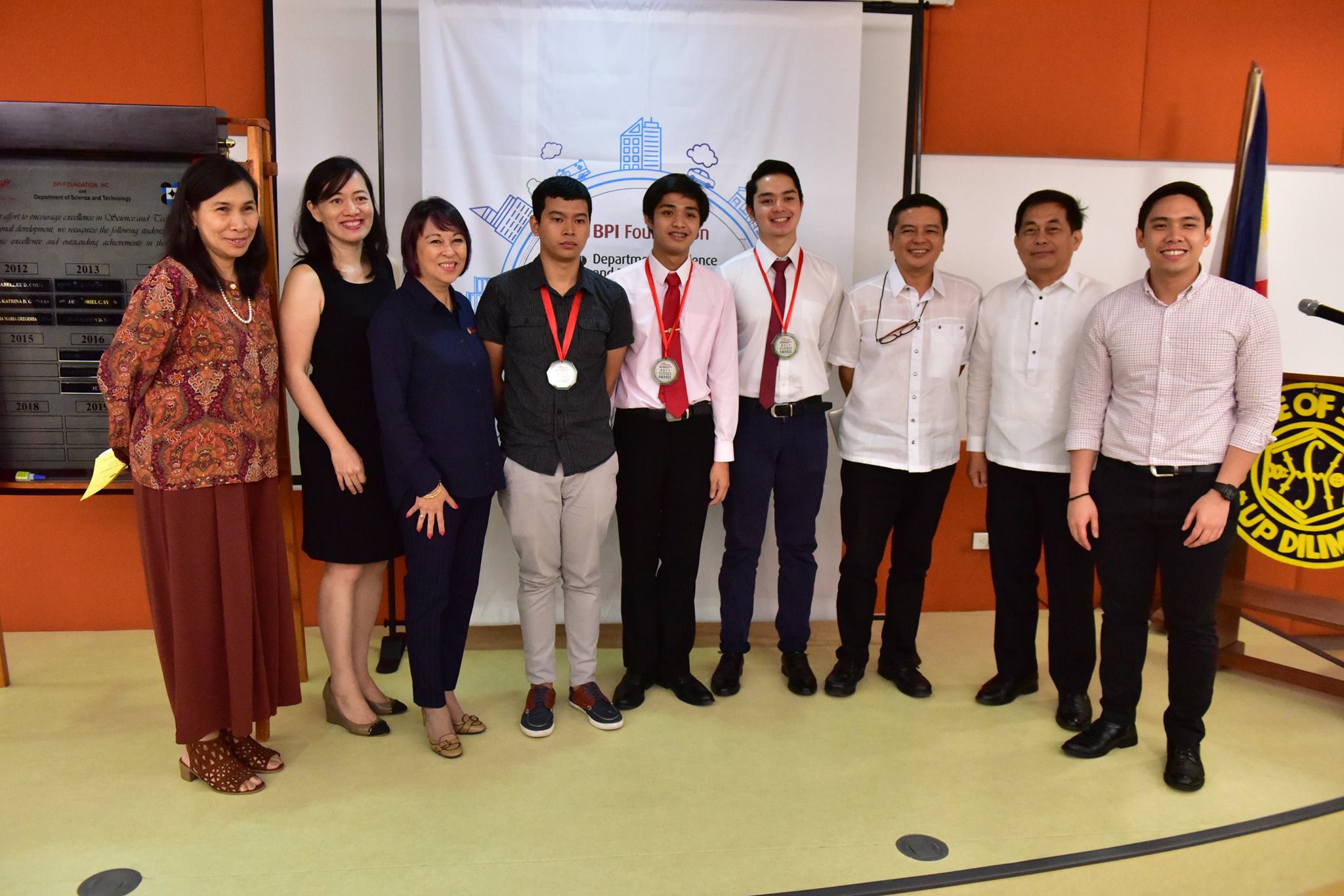
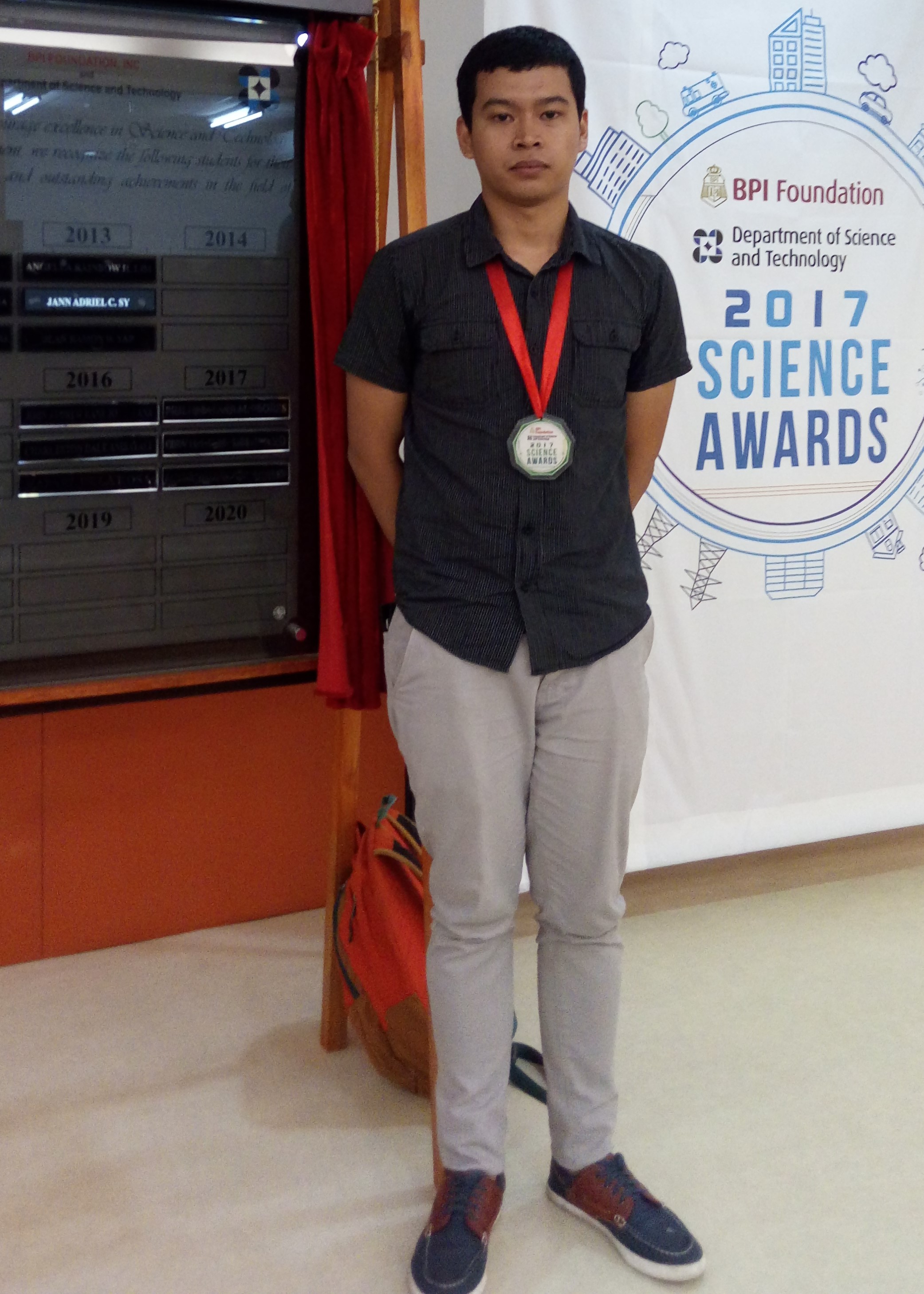
I was able to publish a paper on Physical Review A, and three conference proceedings from this thesis. Moreover, I was awarded the BPI-DOST Science Award 2017 and Leticia Shahani Award for Best Undergraduate Thesis in Physics.